بِسْمِ اللّٰهِ الرَّحْمٰنِ الرَّحِیْمِ
Indo-Pak Nastaleeq
The sloping, stacked hand used in mushafs across Pakistan, India and Bangladesh. If you learned to read from one of those, this is the shape you know.
A wird is the share of the Quran you commit to reading each day. This app keeps track of yours: what you read, where you stopped, and how the habit is holding up over a month.
See it
The streak, where you left off, and the verse of the day, on the screen you actually open. No dashboard to dig through first.
A grace day is built into that streak count, so a missed day shows up honestly rather than resetting it to zero.
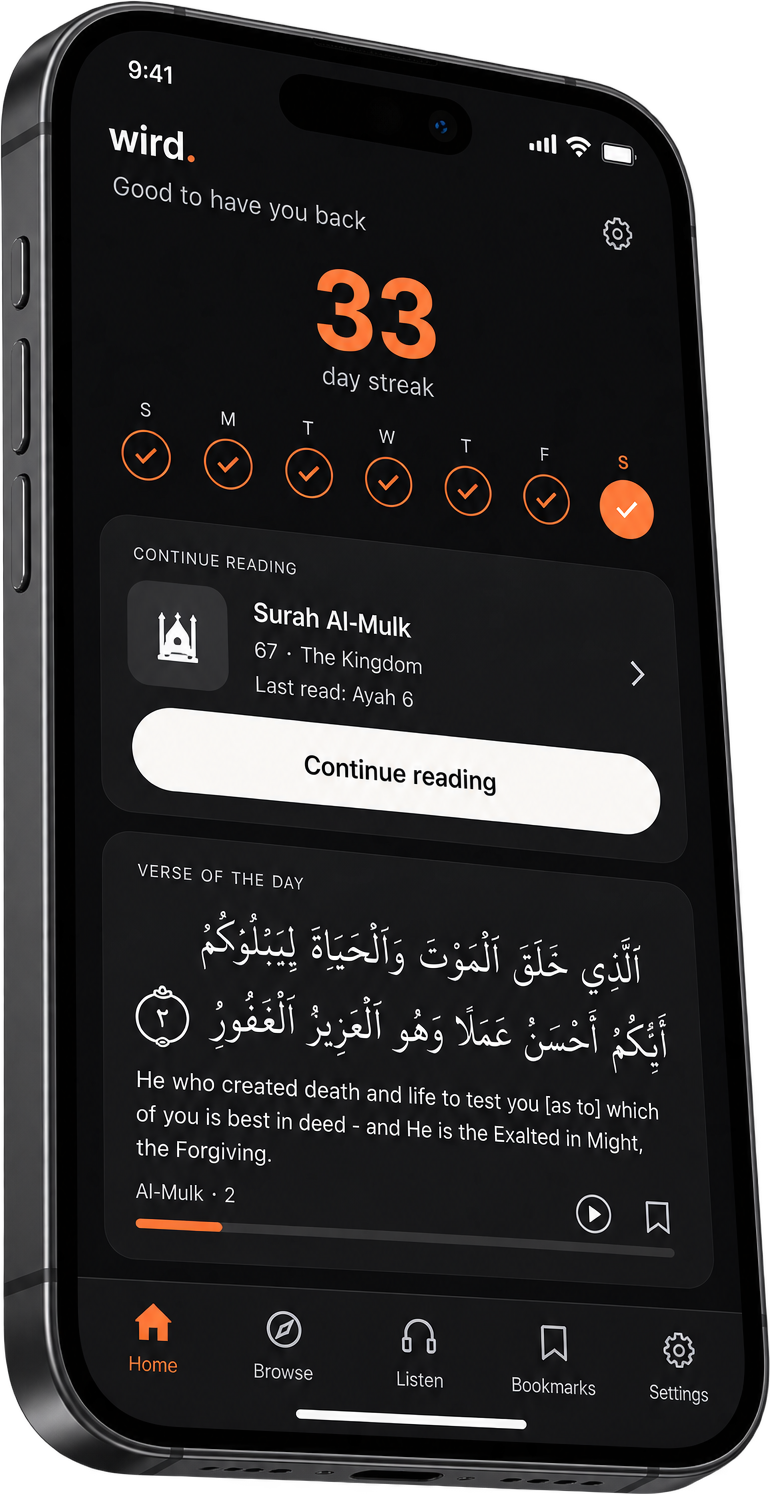
Home - your streak, and where you stopped
The streak
Most streaks reset the moment you skip a day. This one carries a grace day: miss once and the run continues, miss twice in a row and it starts over.
The calendar shows the whole month, so a good run is something you can see rather than a number you have to trust. Reading activity and actual Quran completion are tracked separately.
Day 10 was missed. The grace day absorbed it, so the run kept going instead of dropping back to zero.
Reading
These are genuinely different hands, not one font at three sizes. Each is paired with the text edition it was drawn for, so the letterforms sit the way they do in a printed mushaf. Below is the same opening line, set three ways.
The sloping, stacked hand used in mushafs across Pakistan, India and Bangladesh. If you learned to read from one of those, this is the shape you know.
Upright and even, the standard in most of the world including the Madinah mushaf. The most widely recognised of the three.
The same Uthmani text, with the recitation rules colour-coded in the letters themselves. Useful when you are reciting rather than reading silently.
Saheeh International sits under each ayah for the close reading. When a verse isn't landing, one tap swaps in The Clear Quran, which is written in plainer English, and it stays switched until you change it back. A transliteration line can be turned on underneath.
Listening
In the app, tap play beside any surah and it recites all the way through, moving from one ayah to the next on its own, then carrying on into the surah after it.
It keeps playing with the screen locked and the app closed, and shows up on your lock screen with pause and skip like any music app. So you can listen on a commute, while cooking, or falling asleep, without holding the phone.
Four reciters, switchable whenever you like.
Streams from everyayah.com, the same source the app uses.
New in 1.9.0
Seven short recitations with real hadith behind each one, the kind of thing worth doing before sleep. One guided pass through all of them, one at a time, with a sense of where you are in it.
One card on the home screen starts the whole sequence.
New in 1.9.0, entirely optional
Some habits are easier to keep with someone else keeping them too. If you'd like that, wird now lets you add a friend or two and see how you're both doing, streaks, ayahs, hasanat, nothing more.
You'll get a nudge when a friend reads, the same small "someone else is doing this too" feeling you get from other habit apps, just pointed at something that matters more.
What you get
The full text ships inside the app, so reading works with no signal at all.
Privacy
Local by default. No account required, ever.
Your streak, your position and your stats are written to storage on the phone and stay there. Two things are optional and off unless you turn them on: Friends, and backing your data up with Google so a reinstall doesn't lose it. Neither ever shares which verses you've actually read. See the full privacy policy for exactly what each one does.
Also new
A feedback form now lives right in the app, under About. A bug, an idea, a translation that reads wrong, whatever it is, it comes straight to me.
Releases
The three most recent versions. Older ones stay on GitHub if you need them.
Get it
One file. Nothing to sign up for.